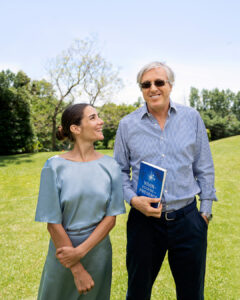
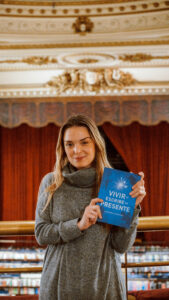
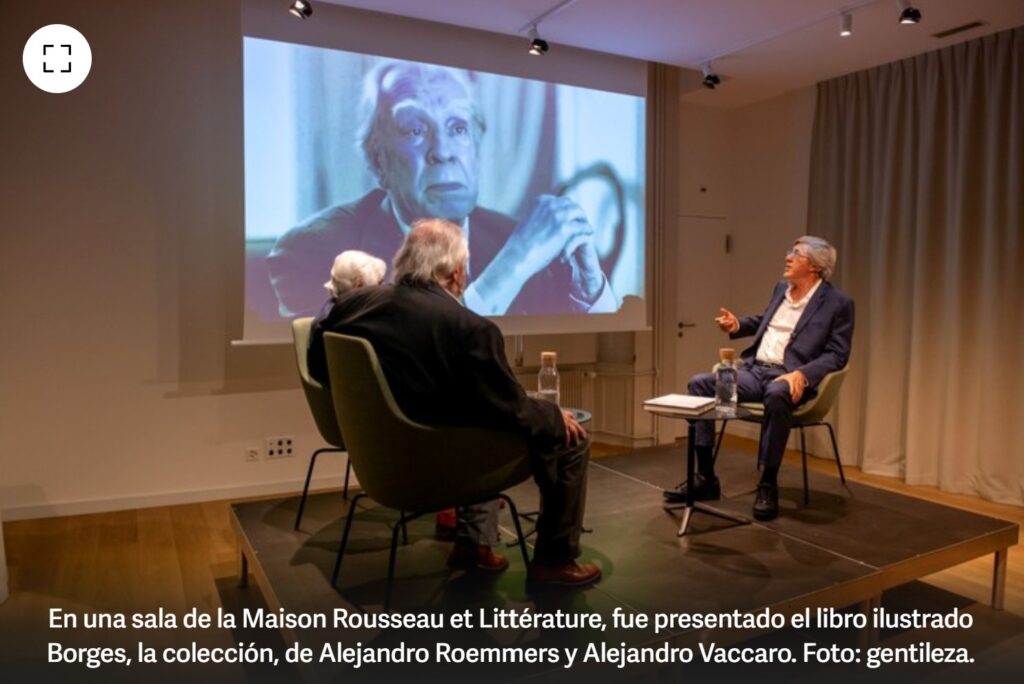
The Swiss city where Jorge Luis Borges lived during his adolescence and chose to die was the setting for a special tribute. There, "Borges, the collection" was presented, a volume that gathers manuscripts, letters, first editions, and objects related to the writer. The event coincided with the 40th anniversary of his death and renewed the debate over the final resting place of his remains.
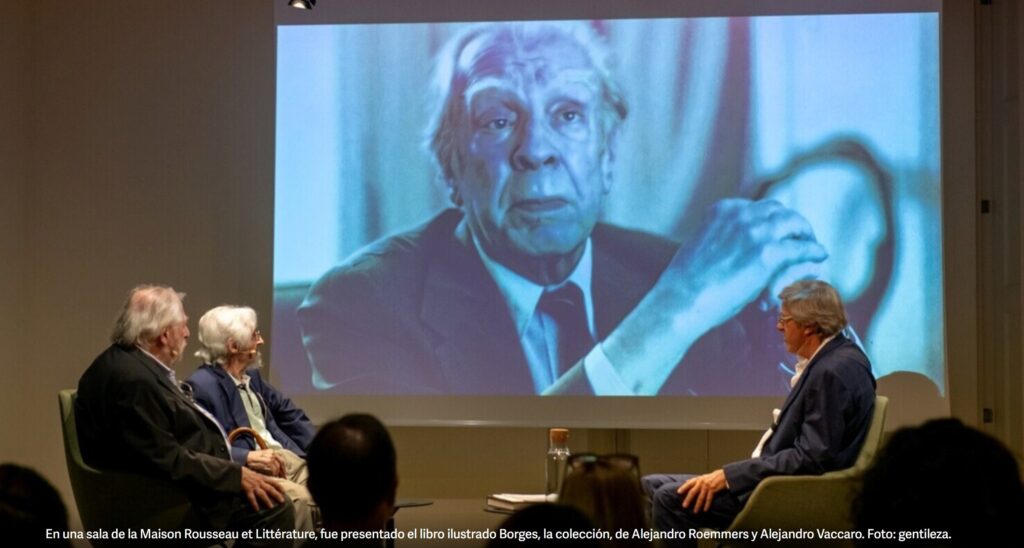
Forty years after his death, here in Geneva, and a short distance from where Borges lived in this city from 1914 to 1918, yesterday, Saturday, in a room of the Maison Rousseau et Littérature, the illustrated book Borges, the collection, by Alejandro Roemmers and Alejandro Vaccaro, owner and curator of the catalog respectively, was presented. Roberto Alifano, author of numerous books of conversations with Borges and heir to his trusty Irish walking stick, also participated.
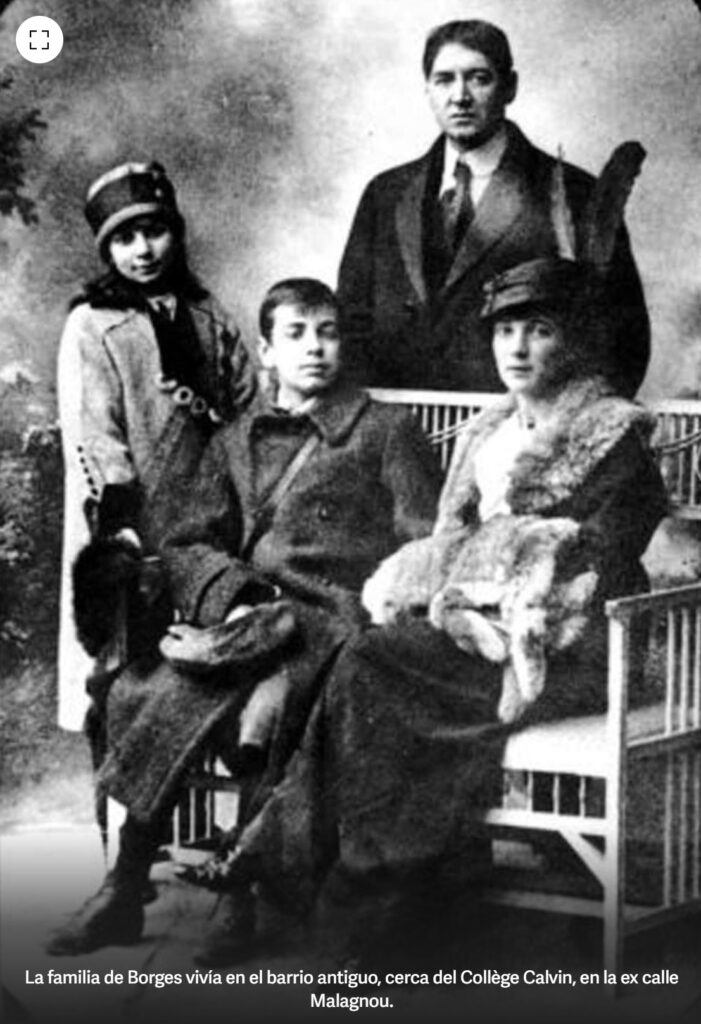
Right around there, “the doubtful streets of the old city,” as he himself said in a letter, just meters from where Borges took his first steps in reading, with the books that left an indelible mark on him: “She was already the one she would become,” one could say, repeating his description of Emma Zunz in the eponymous short story. The history of Borges’s ascending and descending dealings with women, in fact, begins in this uneven city made of slopes, mirages, and variations in altitude.
La Maison Rousseau – Borges was not a fan – saw the multiplication of the revered author’s fictions, resurrecting him with an AI-created animation, which respected his suit jacket and tie, thus emphasizing the elegant anachronism of what a writer used to be.
Vaccaro explained how a collection is a paradoxical blend of chance and addiction and called for the repatriation of Borges’s remains, whose destiny – a term and a sentence that is always evaluated after the fact, and which Borges chose to abide by – dictated that he die here, closing a circle that began on that rainy night when his family first landed in this city, to which he returned more than a few times and always recalled with an ease and affection that advises prudence. Motivations are never monolithic nor entirely visible, and destiny is not in the hands of a single colonel.
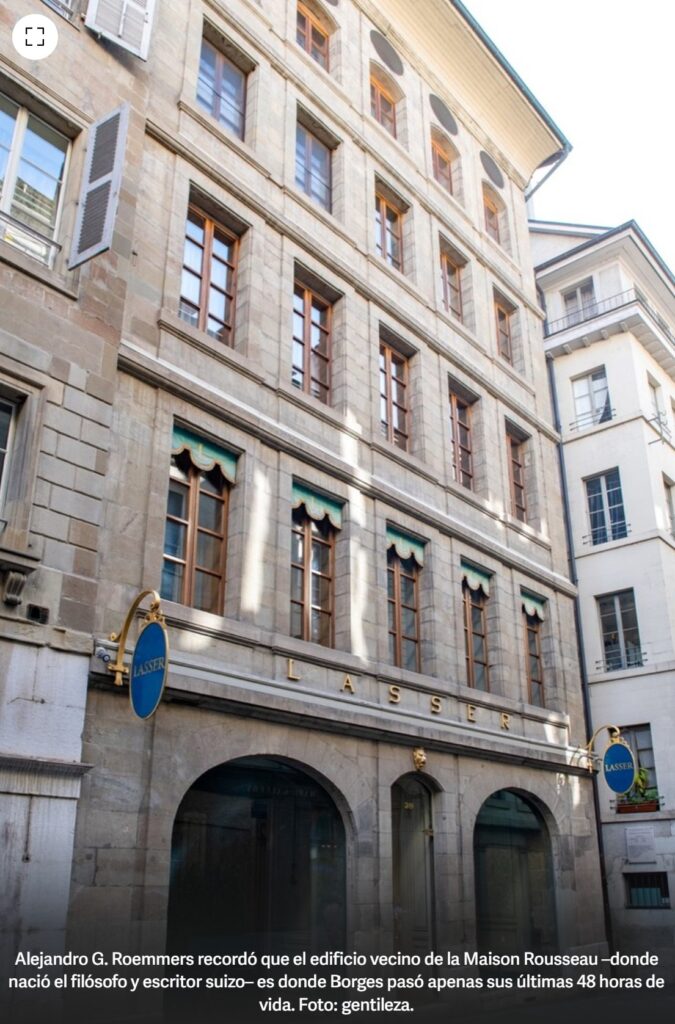
For his part, Roemmers recalled that the neighboring building to the Maison Rousseau – where the Swiss philosopher and writer was born – is where Borges spent barely his last 48 hours of life (although a plaque aims to insinuate a longer duration of that stay). Roberto Alifano recalled Borges’s habit of returning to his texts to continue correcting them, years after publication: “I am the owner of this text and I have the right to improve it,” reasoned the man who continues to emerge unscathed from any kind of approach.
Living materials
The large volume of Borges, the collection weighs like a tombstone, but the material inside could not be more alive. The covers of first editions remind us that on a specific day in the past Borges was newly debuted and had the hope and reality of a few first readers for each flash of brilliance.
Manuscripts (between tamed arabesque and cut-out filigree), dedications, collections he directed as author and promoter (paying off a debt incurred with his favorite authors), magazines in which he translated and contributed, his own books in translation, artistic portraits (from his sister Norah Borges to Sábat, Presas, and Alonso). Documents, objects, and correspondence from the family and friends circle. At the Maison Rousseau, several letters and postcards from his decisive Swiss phase are on display.
The aura of the photos (if anyone sees it without knowing anything about him, they can easily infer that it was someone touched by a not-overly-distracted god) reminds us that he did not see himself, that he didn’t see himself for almost forty years. He guessed at his appearance. Among other things, he could not appreciate that very thing: his evident, prophetic photogenic quality. As if, despite his blindness, he had known how to pose.
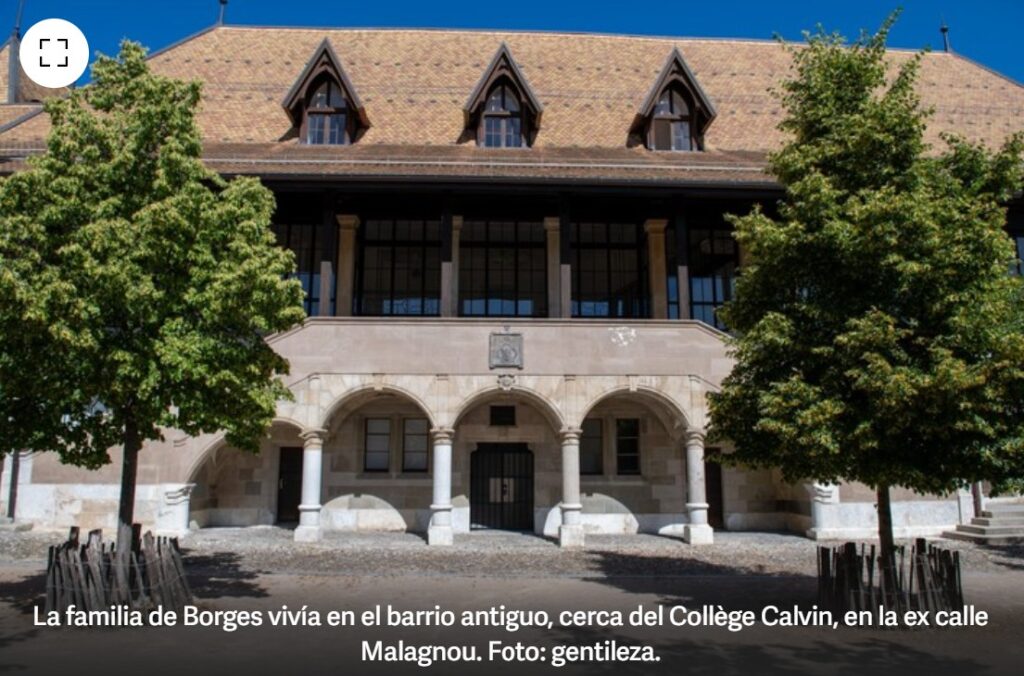
It was in Geneva – different yet the same – where a young Borges grew to hate algebraic cube roots; later, by way of revenge, he would set himself problems in hypotheses that were more complex. It was here that he began learning to translate himself. His family lived in the old quarter, near Collège Calvin, on the former Malagnou Street, now renamed Ferdinand Hodler in honor of the painter Borges would eventually mention.
That street remains slightly steep, with a vast view and the domes of the Russian church within reach behind a high open space. Upstairs, on an intact floor, are the rooms where Borges inaugurated a school year over a century ago that has no end. At the back, as back then, lies the unbought silence of the Alps. In the dictated autobiography he published for the first time in the New Yorker, he noted: “I still know Geneva much better than Buenos Aires, which is easily explained because in Geneva no two corners are alike, and one quickly learns the differences. Every day I walked along the Rhône, a cold, green river that runs through the center of the city and is crossed by seven bridges completely different from one another.” With Geneva in the background, he alluded to “the temptation of suicide,” as if tracing a cut across a calm lake with Ockham’s razor or a Swiss army knife.
Geneva is a city that, like Borges, cannot be captured; it is in fact the only city that could overshadow Buenos Aires in his intimate geographical pantheon. Bioy Casares would clarify these matters months after Borges’s death, in February 1987: “More than once I stated: ‘Borges told me that to die, one place is as good as another. Geneva was not an exile for him. He always remembered it with nostalgia'”. Clearly, Geneva was for Borges a less psychedelic but equally powerful aleph.
A local association with Argentine roots, “Los conjurados,” organizes courses and events—like the one this afternoon at the Maison Rousseau—and informative, entertaining tours led by Marcos Liyo. It is thus that, among other things, the stroller can learn that in Switzerland students attending public schools do so based on proximity, without the right to choose. Or that along the way, it is in the side details—a stone wall that perhaps brushed his school briefcase, or an elevated garden where he surely walked—that for seconds a captivated excursionist perceives, perhaps in a manner similar to the telescopic effect of Borges’s nearly non-existent sight, flashes of light.
Geneva is not emphatic
It was here in Geneva that this master of transpositions returned from his visit in his final years, dictating the following, included in the book titled Atlas: “Unlike other cities, Geneva is not emphatic. Paris does not ignore that it is Paris, dignified London knows that it is London, Geneva hardly knows that it is Geneva. The great shadows of Calvin, Rousseau, Amiel, and Ferdinand Hodler are here, but no one reminds the traveler of them. Geneva, somewhat like Japan, has renewed itself without losing its yesterdays. The hilly narrow streets of the ‘old city’ endure, the rhythmic ringing of bells and drinking fountains endure, but there is also another great city of bookstores and Western and Eastern shops. I know I will always return to Geneva, perhaps after the death of the body,” he concluded, perhaps hinting that he might advance the dates of that prophecy.
It was here in Geneva that his admired Conrad set his visionary novel Under Western Eyes. But Borges—who saw in dreams—preferred The Shadow-Line. The pretext of consulting an eye doctor was what his father used as an excuse to move with the family to Geneva during those years.
It is what led James Joyce to Zurich, where he is buried and whose fate Borges did not know he would mimic four decades later when writing his poem “Invocation to Joyce”: “You, meanwhile, forged / in the cities of exile, / in that exile which was / your hated and chosen instrument, / the weapon of your art.”
It is curious that in both, orderly and disorderly, the classic and the disruptive coexisted. Both invented a key to be read (the person and the work), and in both cases it is their lines that best reweave an unblemished aura, a far from unanimous myth, an indivisible plot.
“Borges is always better in Spanish… A writer’s destiny is his language,” noted the insightful Peruvian critic and translator Luis Loayza, who was a neighbor for long decades of the sun and snow of Geneva. Here also spent years and died another fervent reader of Borges, the Spanish poet, essayist, and translator José Ángel Valente, who visited him once at the National Library on México Street and used to underline in Borges “the implacable fickleness of identities” and “his very secret virtues, such as the capacity to face derision and scorn… You have helped us to dismantle the clumsy image of the writer inflated by his own opinions… You have had the delicacy of not wanting to leave us a work, that soft idol or elephantine wife with which so many overwhelm us.”
Meanwhile, this afternoon essayist Alberto Manguel and academic Annick Louis will give talks and lectures at the Maison Rousseau —the former with his usual elegance and serenity, surely, and the latter with her combative lucidity— but beforehand they will read, in Spanish and French, poems next to his tomb. (And one day the world arrived in the city where almost nothing ever happens: because of the large demonstration expected this Sunday against the G7 being held nearby in Évian-les-Bains, the cemetery will remain closed, but a special permit managed by guide Marcos Liyo will allow the entry of some devoted intruders for a short time).
The inscription on the gravestone is a condensed nod to the Anglo-Saxon narrative poem The Battle of Maldon and in turn a rephrasing of the biblical phrase “Noli timere” (do not fear). A gentle and tirelessly witty dragon, Borges exercised his considerable courage without realizing it or putting on airs.
It is the most visited tomb in this “Cemetery of Kings” in the Plainpalais neighborhood, a fenced garden, more sunny than shadowy, not at all unreal, where he rests alongside Alberto Ginastera and Ernest Ansermet, where some modernist gravestones stand out like modest installations, and where it is fitting to evoke the deep and accurate sentences that his colleague and friend Silvina Ocampo dedicated to Borges: “He likes to stay as if he were leaving; to leave as if he were staying. In all his travels he looks for Buenos Aires as a bird looks for its nest and a dog its doghouse. He finds his country in the United States, in England, in Switzerland, in Scotland, in Spain.”
According to the variations of light and the frequency with which one comes across little streets of serene geometric outlines, Geneva quickly knows how to be magical, and quietly strives to have bookstores worthy of a Borges. As Pierre Drieu La Rochelle summarized it when visiting Argentina in the 1930s, “Borges is worth the trip.”
By Matias Serra Bradford