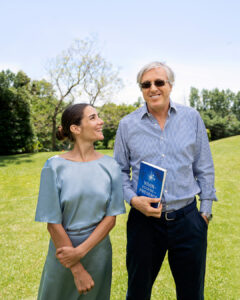
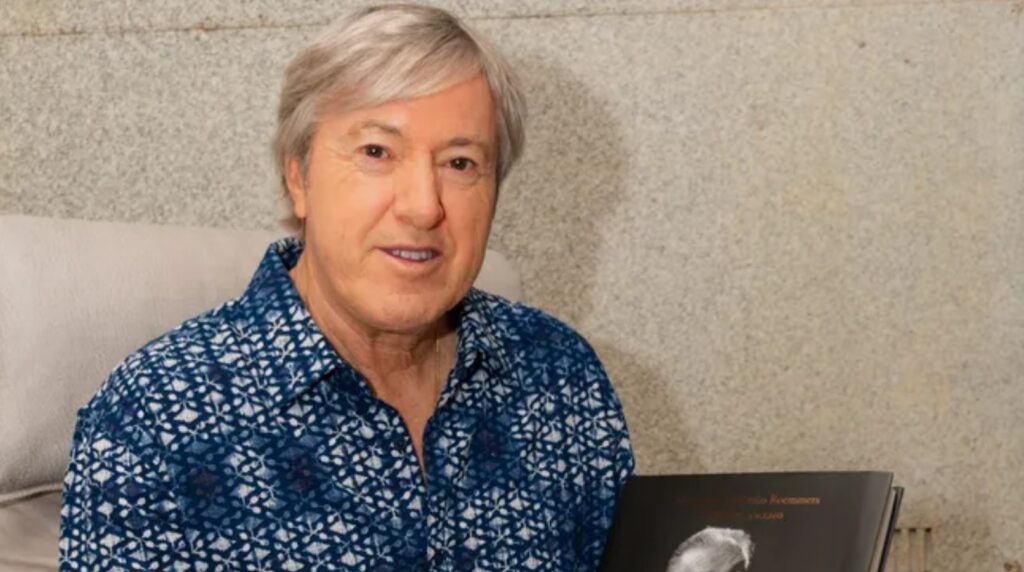
Alongside Alejandro Vaccaro, president of the SADE, the poet and businessman presented a book of more than 500 pages that delves into the creative and intimate world of Argentina's greatest writer.
Following its national and international presentation, an unexpected work in many ways has arrived in bookstores. It brings us face-to-face, visually and materially, with the life and work of Borges. It turns the reader into a spectator of both the public, globally acclaimed Borges, while revealing his intimacy.
“Borges. The Collection” (Granica) is a joint work by businessman, storyteller, and poet Alejandro Roemmers and Alejandro Vaccaro, a collector, Borges specialist, and current president of SADE. At first glance, it is a monumental work—an art book. Its more than five hundred pages form a gallery filled with the most diverse images, accompanied by texts in Spanish and English that broaden the understanding and value of what is being viewed. And to complete it, the book features a prologue by Mario Vargas Llosa.
For some, it will sit on their coffee table; for researchers, it will be a tool; for others, a sensitive approach to the world of Borges. Together with this book, Alejandro Roemmers has a personal proposal that seeks not only to expand the national documentary archive of the great Argentine writer, but also to create a public space to visit the extraordinary Borgesian material currently owned, as well as new items recovered abroad. To learn about “Borges. The Collection” and joint projects, we spoke with Alejandro Roemmers.
Journalist: How did the idea arise to make a book featuring such extensive and diverse collection materials on the life and work of Borges?
Alejandro Roemmers: The idea of “Borges. The Collection” grew out of the conviction that these materials should not remain hidden away and known to only a few, but rather be made accessible to the public. Alejandro Vaccaro had begun gathering items related to Borges over fifty years ago. In 2019, I acquired that collection, which consists of some thirty thousand manuscripts, letters, first editions, photos, magazines, dedications, documents, and personal objects. The book was a way to make a representative selection of this huge archive accessible through images of a thousand pieces, organized into twelve sections, allowing readers to get closer to Borges through original texts, his corrections, correspondence, photographs, and objects that were part of his life. The volume, spanning over five hundred pages, features a preface by Vargas Llosa. As I stated at the presentation in Madrid, “these treasures could not remain locked in trunks and fall into oblivion.”
J.: What do you consider to be one of the key values of this rich catalogue?
A.R.: For example, it allows us to discover not only the finished work, but also the doubts, amendments, and various stages of Borges’ creative process. In the presentations of “Borges. The Collection”, essayist and journalist Roberto Alifano, who was Borges’ secretary and worked alongside him for years, took part by contributing memories and testimonies about the life and work of the author of “The Aleph”.
J.: How did you establish your relationship with Alejandro Vaccaro?
A.R.: I met him at a tribute to Borges at the National Library of Madrid, held ten years after his death. As a gesture of reciprocity from Argentina toward Spain, Vaccaro and Alifano contacted me to compile in a book the poems I had dedicated to that country; that is how “Spain in Me” was born, which I presented there in 1996. Sometime later, I received two Fajas de Honor from SADE: one for “The Return of the Young Prince”, and another for one of my poetry books. By then, Vaccaro was already presiding over SADE, which named me Ambassador of Argentine Letters. Thus, our relationship continued through meetings and literature-related projects.
J.: What projects are emerging from “Borges. The Collection”?
A.R.: What matters most to me is the creation of a museum dedicated to Borges in Argentina. When I acquired the collection, I made it a condition that its destination be an interactive and entertaining space open to schools, young people, and visitors of all ages, allowing them to engage with Borges, his life, and his work through documents and objects.