From Rome, the businessman and writer shares details of the global call that will unite Assisi and Buenos Aires in a reflection on peace, fraternity, and universal dialogue.

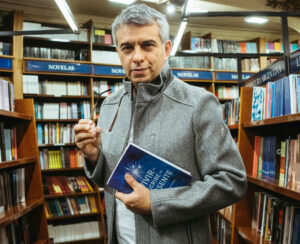
As part of the 800th anniversary of the death of Saint Francis of Assisi, writer, poet, philanthropist, and businessman Alejandro Roemmers spoke with Jorge Fontevecchia on Modo Fontevecchia, on +Perfil and Radio Perfil (AM 1190). Having just arrived in Italy, the Ambassador for Peace reflected on the ecumenical impact of the Franciscan figure in a global context marked by wars and divisions. He also explained the meaning of “A Hug for Humanity,” the international initiative that seeks to promote dialogue and that will be replicated next Sunday at the Buenos Aires Planetarium.
Alejandro Roemmers is a writer, poet, philanthropist, and businessman known for combining his role in the pharmaceutical industry with a prolific literary and artistic career focused on human values and spirituality. He was appointed Ambassador for Peace by the World Organization for Peace to promote the values of fraternity, dialogue, and global understanding.
Alejandro, good morning, or rather good afternoon to you there in Assisi. October 4 marks the 800th anniversary of the death of Saint Francis of Assisi, and you are organizing a “hug for humanity” there, which also promotes events not only in Assisi but also at the Argentine Planetarium. Share with our audience what drove you to carry it out and, looking ahead a bit, what the event will be like.
Hello, Jorge. Good afternoon, everyone. I’ve actually just arrived here in Rome. Look, the idea, since it’s exactly eight centuries, is to do something that doesn’t just remind us of, let’s say, a tribute to Saint Francis, but something that truly sends a message to today’s world, something useful to us today, right? A reflection. And in a world so divided in many places, with wars and confrontations, Saint Francis’s message is more relevant than ever. His phrase “we are all brothers” was already very revolutionary in his own time, because back then Muslims occupied what was considered, let’s say, the Holy Land, and there were crusades that were even organized by the Catholic Church. Christians fought to recover territory, and he was against that because he said that human beings are all children of God, they are brothers, regardless of whether or not they believe in God and how they see Him, because they may see Him through their own culture, from different perspectives. So he had a very ecumenical vision. And the incredible thing is that he managed, let’s say, to defend this idea without breaking with the Church, without being… Normally someone would have been excommunicated in that era for making such a statement, when it was understood that the only truth, the only true God, let’s say, was the one proclaimed by one’s own church, whichever side it was. But not him; his vision placed humankind, the human being, above their beliefs. And I think this is very important today. That is, to reclaim the idea that above any difference of ideology, of thought, of any kind, or of religious faith, there is the reality that we are human beings, we share this home that is planet Earth, and in some way we all have, let’s say, a hope, a heart, a spiritual soul that are similar. So I think this is a very good message nowadays. In the past, I have called for hugs before; with Pope Francis we held two very important hugs in Rome with young people from all over the world. This time the idea was to do it in Assisi, but, well, the Italian government wants to hold its own tribute in Assisi, where they preserve the cell where he lived and a stone where he rested his head. So we want to do something smaller, more intimate there, also with people of different, let’s say, religious beliefs and different ethnicities. And then, in Assisi we’ll probably have to do it on the 5th, because the 4th is… even on the 3rd they won’t let us in due to security protocols, so we have to move it by a day.
Alejandro, how much of this recognition you repeatedly give to Saint Francis of Assisi is, indirectly, a form of continuity with Pope Francis?
Look, I had actually become very interested in Saint Francis of Assisi long before I met Bergoglio, our Pope, and I had read several books about him. In total I think I’ve read about eight, because several Nobel Prize winners, including Hermann Hesse and Kazantzakis, have written books about Saint Francis of Assisi. I made the musical Franciscus. And I’ve even dedicated a couple of poems to him, which I always sent to Jorge Bergoglio, even when he was a cardinal, and we shared a great love for poetry and also that affection for Saint Francis. And, well, I don’t know whether in some way I may have had a little influence on his choice of name or not, but when he chose that name, I felt a sense of closeness. Afterwards I was, I think, five or six times at the Vatican with Pope Francis, I collaborated with him on several things, and we even organized football matches for peace. But always, let’s say, with a message that went beyond the Catholic religion, even beyond Christianity, always embracing all human beings, whether or not they have a religion. And, well, I’m continuing somewhat along this line, and I know that he, who had a close friend who was a rabbi and also had friends in Muslim communities, was always deeply convinced of the dignity and spirituality of the human being beyond any belief. So, in that spirit, let’s say, I keep him very, very present. In fact, here in Rome I want to go and pray at his tomb, which is so simple, just as he asked. Also following that Franciscan spirit.
And right across from the Argentine Embassy, which apparently is no coincidence, right?
That I don’t know, no, but he didn’t believe… I think that’s not a coincidence. He loved the Basilica of Santa Maria Maggiore; when you enter Rome you always come across this church, and so…
He always went to pray there when he traveled to Rome, but it’s no coincidence that from the very beginning he always went to pray at that church, and that Argentina’s representation was right across the street. Alejandro, best of luck, and congratulations on this new initiative, which is very beautiful. We wanted to give it visibility, send you a hug from afar, and wish you all the best.
Well, if you’ll allow me one little thing, Jorge…
Whatever you want.
I took the liberty of calling for a hug in Buenos Aires, my city, in Argentina, my country. And a large group of friends said: “Yes, yes, we’d gladly like to take part.” So, well, we spread the word about the possibility of holding a hug. The City Government decided to support it, so this Sunday at 7 p.m. at the Planetarium, there in Palermo, well, some kind of hug will happen. We don’t know how, because the idea was not to organize it too much. I think Flor Otero will probably say a few words or read what I wrote. But in principle it’s a spontaneous hug among people who simply want, in some way, to commemorate Saint Francis and pay tribute to him on these 800 years. And also, in a way, we in our country have our own divisions, our own rifts, so it’s also about sending a message to the world of fraternity and that we all want peace.
Doubly necessary. Thank you very much, Alejandro. A big hug, and we’ll see you when you return here to Argentina.
Thank you very much. My pleasure, Jorge. A big hug.
MEG