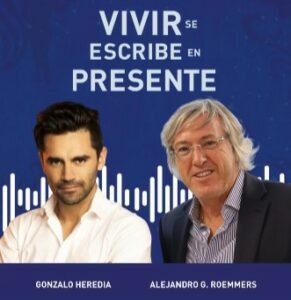
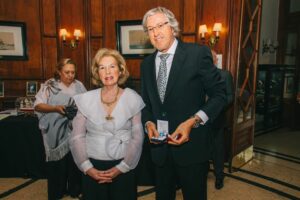
The author of The Return of the Young Prince, a work translated into 32 languages, has been honored with the “Madrid, Capital of Ibero-America” award in the Cultural Initiative category.
Madrid is not only an important city in the career of Argentine writer, poet and philanthropist Alejandro Guillermo Roemmers, but also the place where his literary vocation first began to take shape. That personal and cultural connection with the Spanish capital has now taken on new meaning after he received the “Madrid, Capital of Ibero-America” award in the Cultural Initiative category, in recognition of his career and his contribution to bringing Spain and Latin America closer together. The award was presented yesterday, October 15, during the second edition of these awards, organized by the Business Council Alliance for Ibero-America (CEAPI) together with Madrid City Council, at a ceremony held in the Cecilio Rodríguez Gardens in El Retiro Park and presided over by the Mayor of Madrid, José Luis Martínez-Almeida.
In his speech, Roemmers highlighted the dual meaning Madrid holds for him: a city that is part of his personal history and, at the same time, a meeting place between Spain and Ibero-America. In this regard, he championed the capital’s role as a point of union between different cultures and identities that share the same language.
“Madrid is a meeting place for all our voices in Spanish,” the writer stated, highlighting the city’s ability to bring together and connect the different cultural expressions of the Spanish-speaking world.
Roemmers also recalled that it was precisely in Madrid that he began to discover his literary vocation. “A decisive stage of my youth took place here: here I studied, made friends and began to discover, with the intensity typical of those years, everything that literature could mean in my life,” he said.
An international literary career shaped by love and human values
The author of an extensive body of poetry and prose, Roemmers has built a literary career centered on human feelings, love, solidarity and the search for meaning.
Among his best-known works is The Return of the Young Prince, a book translated into 32 languages that revisits the literary universe of Antoine de Saint-Exupéry and offers a reflection on human values and the importance of personal bonds.
His literary output also includes poetry collections such as Dreamers, Dream, Fleeting Anchor and Spain in Me, the latter especially representative of his emotional and cultural relationship with Spain.
Beyond his work as a writer, Roemmers has carried out philanthropic work linked to the promotion of culture and universal values, a dimension that complements his literary activity.
“Words can build walls, but they can also build bridges”
During the ceremony, the writer championed literature’s ability to bring together people from different cultures, generations and countries, and highlighted the role of the Spanish language as one of the main elements uniting both sides of the Atlantic.
“Our language does not belong exclusively to one country or to a single tradition. It is a living heritage, built over centuries by millions of speakers and enriched by the diversity of our accents, our cultures and our experiences,” he said.
In this regard, Roemmers stressed the need to understand culture not only as an artistic expression, but also as a tool for fostering dialogue, empathy and understanding.
“Words can build walls, but they can also build bridges; they can divide us, but they can also help us understand one another,” he stated.
A recognition of his cultural and literary career
The “Madrid, Capital of Ibero-America” award recognizes careers and initiatives that help strengthen cultural, social and business ties between Spain and Latin America.
In this second edition, alongside Alejandro Roemmers, Carlos Vargas was also honored for his contribution to business ties between the two continents, as was Miguel Henrique Otero, for his career defending independent journalism and freedom of expression.
The writer thanked Madrid City Council and Núria Vilanova, president of CEAPI, for the recognition, and underscored the value of the Spanish capital as a meeting place for different identities and cultural traditions.
“If literature has any mission worth defending, perhaps it is precisely this: to help us find one another in what makes us different and, at the same time, deeply human,” he concluded.